Tent Footprints: Match the Model, Dimensions and Attachment System
A footprint is an additional ground layer, not a universal cure for a poorly chosen site or a leaking shelter. Its dimensions and attachments need to match the tent. Check those details before assuming that a sheet with a similar advertised capacity will work underneath your particular model.
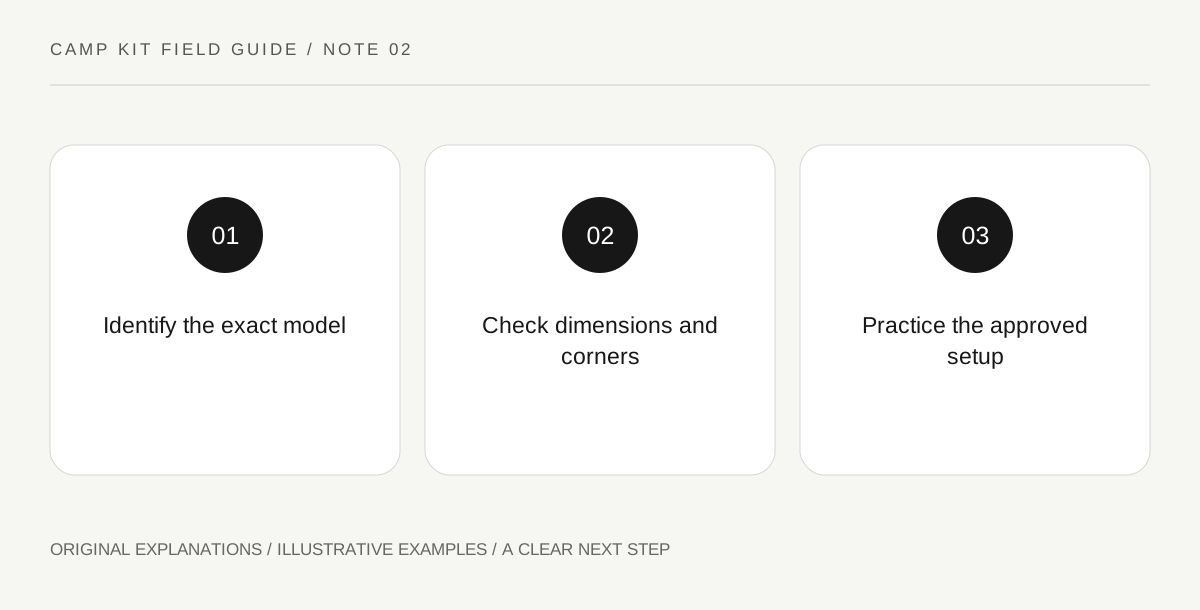
Original explanatory diagram. Read the full method and limitations below.
Identify the exact shelter version
Record the tent’s full model, capacity and version before looking for a footprint. Manufacturer compatibility information is more useful than a seller’s broad claim that one accessory fits two-person tents. A revision to floor shape or attachment points can matter even when the product family name stays familiar.
Compare any stated compatibility chart with the shelter you actually own or plan to rent. Ask whether the footprint is included, optional or unavailable for that version. Keeping the accessory decision tied to the exact shelter avoids discovering mismatched clips or dimensions when the tent is already being pitched at the campsite.
Understand why oversized is not automatically better
A groundsheet extending beyond the intended tent floor can collect water and direct it toward the space between layers. The manufacturer’s footprint design accounts for the floor and rainfly relationship. Cascade Designs explains that its footprint sizing is intentionally smaller than the corresponding floor for this reason.
That principle does not authorize copying one brand’s dimensions onto every shelter. Use your model’s instructions and compatibility information. A photograph showing a large sheet under a tent is not evidence of correct wet-weather fit. The useful comparison concerns the protected floor and water path rather than maximizing the visible area of fabric.
Check how the parts connect
A footprint may use particular grommets, buckles or corner arrangements. Lay out the components during a permitted practice setup and compare orientation and attachment points with the manual. Avoid forcing an incompatible connection or modifying load-bearing shelter parts just to make an accessory appear to fit.
Some products advertise alternative pitching configurations. Those configurations are model-specific and can omit features provided by the full tent. Do not infer that every footprint and rainfly combination makes an equivalent complete shelter. If a proposed setup is absent from the manufacturer’s instructions, ask the manufacturer rather than treating a visually plausible assembly as a verified system.
Treat it as one layer of care
A footprint can help protect the floor from dirt and abrasion, but it cannot make every surface suitable. Choose an authorized site and follow local requirements without damaging vegetation or altering the ground. Inspect for obvious sharp objects within normal low-impact site use, and keep the tent floor clean.
After the trip, separate and dry the layers according to their care instructions. Storing damp fabric together hides moisture and makes later inspection harder. Record holes, coating changes or damaged attachments while the shelter is unpacked. A footprint is most useful as a compatible maintained component, not as a promise that the tent underneath no longer needs care.
A planning scenario
A camper finds an accessory advertised for a two-person shelter but discovers its corners belong to an older floor design. Instead of stretching attachments or allowing excess fabric to protrude, they check the current compatibility chart and practice the approved setup. Their notebook records the exact tent version and footprint code. This scenario illustrates a compatibility decision, not a claim that a particular aftermarket sheet will work with every tent.
Practical checks
Optional checkboxes save only in this browser.
Questions that come up
Does a footprint replace waterproof floor maintenance?
No. It is an additional protective layer with its own limits. A damaged floor, unsuitable site or incompatible setup still needs attention according to the shelter instructions.
Can one universal sheet fit any tent?
A sheet’s usefulness depends on dimensions, water management and how it is used. Do not assume a capacity label establishes compatibility; compare the actual shelter and its manufacturer guidance.
References and scope
These sources support the factual background. Examples and exercises are original illustrative teaching material. References do not imply endorsement.
- Cascade Designs: Matching a tent footprint — Model-specific footprint compatibility, abrasion protection and why footprint dimensions matter.
- Cascade Designs: Tent cleaning and drying — Model-family care instructions, moisture and storage limitations.