Tent Condensation: Notice Moisture Sources Before Blaming the Fabric
Water droplets inside a tent do not all have the same explanation. Occupants, damp equipment and humid conditions can contribute to condensation. Learn to identify the pattern, use the shelter’s intended ventilation and record what happened before declaring every wet surface a hole or a failed waterproof coating.
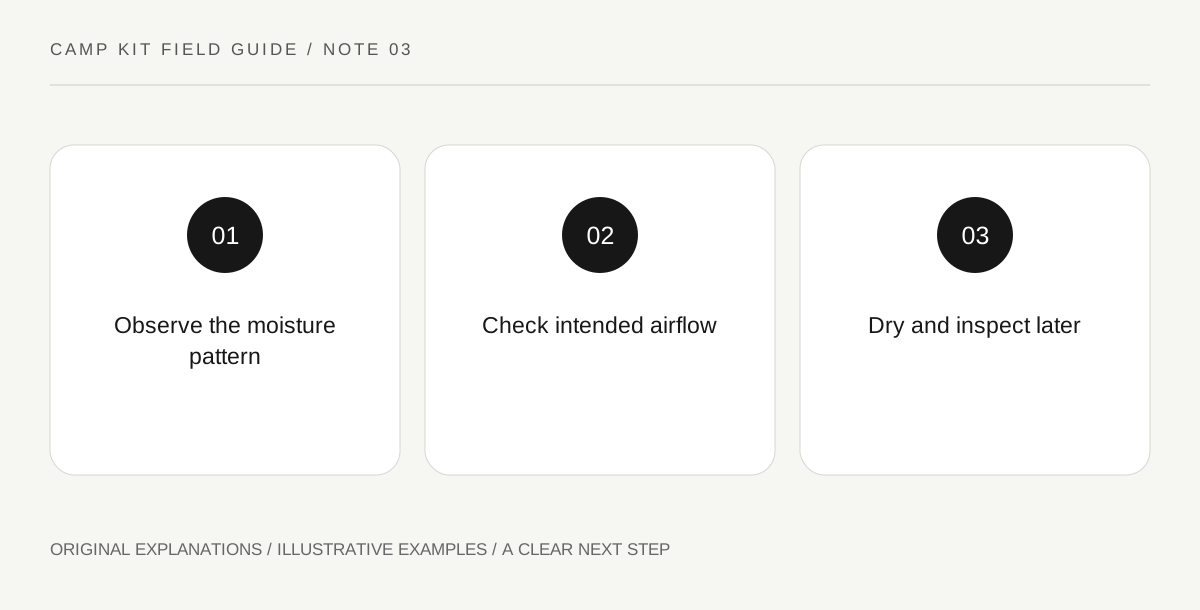
Original explanatory diagram. Read the full method and limitations below.
Describe where the moisture appears
Note whether droplets cover the underside of a fly, collect near damp belongings or enter through a particular damaged area. A broad damp surface and a localized flow during rain suggest different questions, though appearance alone cannot prove the cause. Record conditions and the assembled setup rather than jumping to a diagnosis.
Do not conduct a risky experiment in worsening weather to establish the answer. Keep bedding protected and use a safer alternative if the shelter is not functioning adequately. Later, inspect in controlled conditions and consult the manufacturer about suspected leaks or coating problems. An educational guide cannot certify a shelter from a description of wet fabric.
Recognize indoor moisture sources
Breathing and body moisture contribute to the air inside an occupied shelter. Wet clothing or gear adds another source. Cool surfaces and humid weather can make condensation more noticeable. The important point is that a waterproof outer layer does not remove all moisture generated within the system.
Keep wet belongings organized so they do not transfer moisture to bedding. Do not bring food-contaminated items into a sleeping area contrary to local storage rules merely to keep them dry. Different equipment needs require different solutions: weather protection, wildlife storage and ventilation should be considered together rather than one being used to cancel the others.
Use the designed ventilation options
Read how your model’s vents, fly spacing and doors are intended to work. Manufacturer guidance may explain cross-flow or raised vents, but the appropriate arrangement depends on weather and the shelter design. Do not cut fabric, remove necessary weather protection or assume one open-door arrangement suits every situation.
A properly assembled fly and its approved tensioning can help preserve the designed separation and airflow. Inspect the setup before blaming the material. Ventilation can reduce condensation in many circumstances, but no configuration guarantees a completely dry interior under every combination of weather and occupancy. Avoid presenting a simple vent setting as a universal cure.
Build a drying and inspection routine
When conditions and site rules allow, air and dry the shelter without obstructing other campers or damaging vegetation. At home, unpack promptly and dry the tent completely according to its care instructions before long-term storage. A wet departure is a reason to plan drying later, not leave the fabric compressed indefinitely.
Keep a brief note of the weather, occupancy, wet gear and vent arrangement. This creates a more useful pattern over several trips than a general statement that the tent is always wet. If a problem persists with correct use, give that information to the manufacturer or rental provider. It helps separate likely condensation from a specific maintenance or compatibility concern.
A planning scenario
After a humid night, two campers notice widespread droplets beneath the fly and a damp jacket touching the inner wall. They protect the bedding, check the model’s ventilation instructions and record the conditions. They do not label every droplet a leak or remove the fly during rain. Once home, they dry the components and inspect for a localized defect separately. This is an illustrative reasoning sequence, not a remote diagnosis of any shelter.
Practical checks
Optional checkboxes save only in this browser.
Questions that come up
Can a better tent eliminate all condensation?
No design should be treated as a guarantee of a dry interior in every condition. Materials, ventilation, occupancy, weather and use all influence moisture, and a specific problem may still require manufacturer inspection.
Does an inner droplet prove a leak?
No. Condensation is one possible cause. A clear record of where water appears, weather and setup helps investigate, but does not by itself establish that every seam or coating is sound.
References and scope
These sources support the factual background. Examples and exercises are original illustrative teaching material. References do not imply endorsement.
- Cascade Designs: Reducing tent condensation — Moisture sources and the role of designed tent ventilation.
- Cascade Designs: Tent cleaning and drying — Model-family care instructions, moisture and storage limitations.