Tent Capacity: Test the Floor With Your Actual Sleeping Pads
A two-person label tells you the intended sleeping capacity, but not how comfortably your own pads, bodies and essential belongings fit. Before buying or renting a shelter, compare the usable floor, wall shape and access. A simple layout exercise reveals limitations that a capacity number leaves hidden.
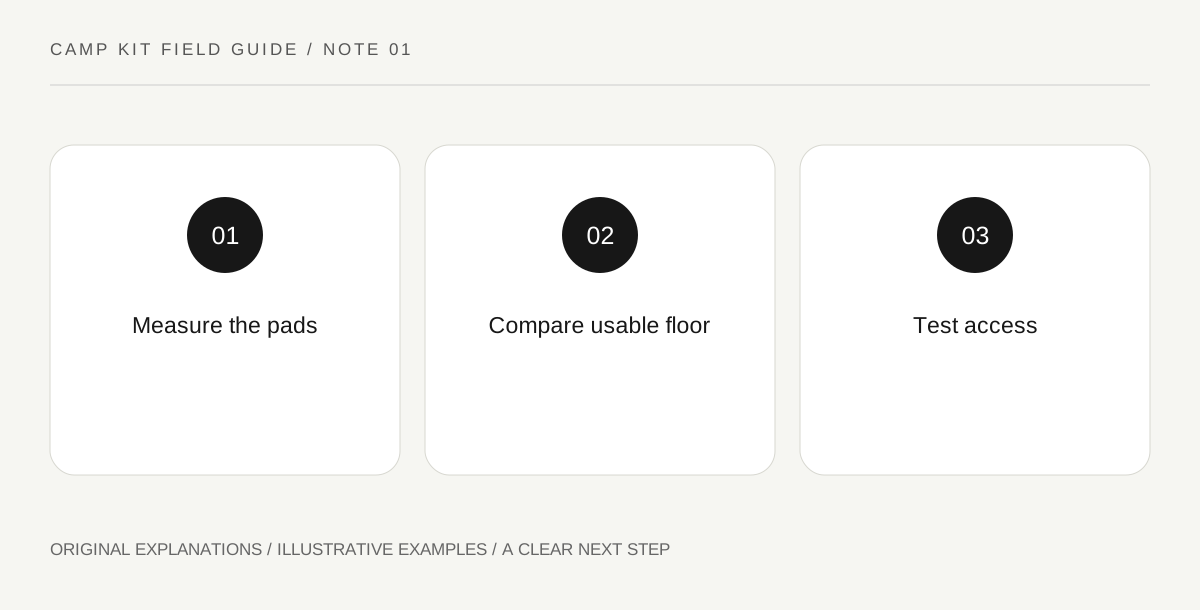
Original explanatory diagram. Read the full method and limitations below.
Begin with the whole sleeping layout
Write down the number of sleepers and the dimensions of the pads they actually use. Include width at the widest point rather than assuming every pad is rectangular or identical. Place them side by side on a floor at home to understand the occupied footprint before comparing tent specifications.
The National Park Service notes that a tent’s person count describes sleeping space rather than people plus all their equipment. Treat luggage and other belongings as additional space needs. Decide what genuinely needs to be inside the sleeping area, what may fit in a permitted sheltered storage area and what must follow separate food-storage rules.
Read the shape beyond maximum dimensions
A tent may taper toward the feet or have sloping walls. Maximum floor length and width do not establish headroom everywhere. Compare a floor plan, the stated dimensions and the actual assembled shelter when possible. Two shelters with similar headline area can feel different when sitting up or moving around.
Use the pad layout to ask specific questions: do broad pads overlap, does a sleeper’s foot press the inner fabric, and can someone sit up without leaning on the wall? A specification sheet is a starting point for these checks, not a complete simulation of how two people will use the space.
Check access without disturbing another sleeper
Door placement affects getting in and out after dark. With two sleepers, consider whether one person must climb over the other and where shoes can be handled without blocking an exit. Test zip operation and reach while sitting on the pads, following the shelter’s setup instructions.
Vestibule space is not interchangeable with an extra sleeping compartment, and it is never a reason to operate a stove inside or near the shelter. Its use must respect the manufacturer’s restrictions and the campsite’s wildlife rules. Keep access and storage questions separate rather than counting every covered area as freely usable indoor floor.
Balance space with the way the tent travels
For a car-access campsite, a larger packed shelter may be manageable if it fits the vehicle, reserved pitch and setup conditions. A backpacking group must also consider the complete carried package, including poles, stakes, fly and required accessories. A spacious shelter that cannot fit the trip’s transport is not a resolved choice.
If renting, ask for an assembled demonstration or enough floor-plan detail to run the same layout check. Record the exact model and version, because a familiar product name can cover different sizes. The decision should connect room, access, packed dimensions and intended conditions rather than reward the largest capacity label alone.
A planning scenario
Two campers use pads 58cm and 64cm wide. Their nominal combined width is 122cm before allowing for wall shape or movement. They compare that layout with an illustrative tent that tapers at the foot, then discover the widest pad cannot stay flat where they planned to put it. The useful response is to test another layout or shelter, not assume that the two-person label overrides the measured incompatibility. This is an invented planning example.
Practical checks
Optional checkboxes save only in this browser.
Questions that come up
Does a three-person tent guarantee comfort for two?
No universal label guarantees your preferred space. Actual pad widths, body dimensions, wall geometry and the intended storage arrangement still matter. Compare the assembled layout where practical.
Can I count a vestibule as cooking space?
Do not use a shelter area to justify operating fuel appliances. Follow the exact stove and tent restrictions; enclosed or sheltered spaces can create serious carbon-monoxide and fire hazards.
References and scope
These sources support the factual background. Examples and exercises are original illustrative teaching material. References do not imply endorsement.
- National Park Service: What to bring camping — Shelter capacity, bedding and the different equipment needs of frontcountry and backcountry camping.
- MSR: PocketRocket 2 owner instructions — An example of model-specific stove, fuel, cookware and windscreen restrictions; not universal operating instructions.