Sleeping-Pad R-Value: Compare Insulation Without Forgetting Fit
Sleeping-pad thickness, softness and insulation are related decisions, but they are not the same specification. R-value gives a reference for thermal resistance under a stated test. Read that information alongside usable dimensions, comfort and the complete sleep system instead of choosing the thickest-looking pad.
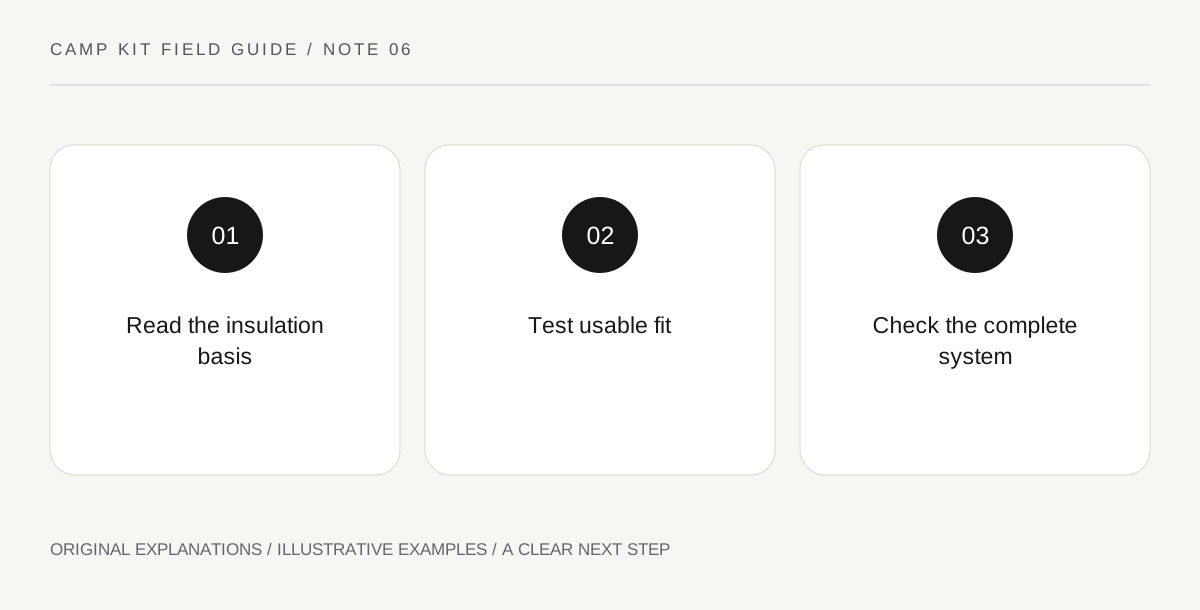
Original explanatory diagram. Read the full method and limitations below.
Find the test basis with the value
Look for a clearly stated R-value and the manufacturer’s explanation of how it was obtained. A shared test basis makes comparisons more meaningful than unrelated warmth descriptions. The public ASTM overview describes a comparative laboratory measurement, with limits on how it represents real sleeping conditions.
A number copied from an old listing may not describe the current model or test basis. Record the full product version and current specification. If a borrowed pad has an unknown rating, do not assign one from its colour or apparent thickness. Ask for the correct model information and treat unresolved uncertainty as part of the equipment decision.
Separate cushioning from thermal resistance
A pad can feel comfortable while providing less insulation than the trip requires. Thickness alone does not reveal internal construction or thermal performance. Conversely, a relatively thin pad can use a different insulating structure. Compare the published insulation information rather than treating physical height as a universal warmth scale.
Comfort still matters: shoulders, hips and normal movement need adequate support. Try the pad on a suitable clean surface, at the manufacturer’s intended inflation level if applicable. A warm specification does not guarantee that the shape suits your body. Keep the comfort check and insulation comparison as two connected but separate observations in your notes.
Include width, length and the bag arrangement
Measure the pad’s actual usable dimensions and compare them with the tent floor. A wide pad may solve one comfort issue but create a shelter-layout problem. A tapered pad can also interact differently with a sleeping bag or quilt attachment system.
Check approved connections and avoid assuming that matching size words establish compatibility. The sleeping system includes the bag or quilt, pad and intended dry layers. Do not add ratings as though a simple arithmetic formula can certify the lowest safe temperature for the combination. Manufacturer guidance and competent advice are important when expected conditions are outside your experience.
Plan for condition and failure
Inspect an inflatable pad for known damage and verify its valve works before departure. A protective surface, suitable repair materials and knowledge of the exact repair instructions belong in the plan. A paper specification does not prove an old or damaged item still functions like a new sample.
For a low-consequence practice setup, notice whether you roll off the pad, whether the pad fits the shelter and how you would respond to an overnight failure. The answer may involve a different trip, a different system or a suitable backup. It should not depend on guessing that the sleeping bag alone will compensate for an unsuitable or deflated pad.
A planning scenario
A hypothetical shopper compares two pads of similar thickness. One has a clearly identified standardized insulation value; the other has only a broad season label. They verify the missing specification, test the intended pad-and-bag arrangement and check the tent floor before deciding. No temperature conversion is inferred from thickness or from this example. It demonstrates a comparison process, not a certification of either pad for a particular night.
Practical checks
Optional checkboxes save only in this browser.
Questions that come up
Does twice the thickness mean twice the warmth?
No. Construction and insulating materials matter, and thickness is not a universal thermal-resistance scale. Use suitable published information for the exact product.
Can this guide calculate my safe minimum temperature?
No. It explains specifications and compatibility questions. Individual needs, conditions, equipment condition and the full sleep system prevent a single universal temperature calculation.
References and scope
These sources support the factual background. Examples and exercises are original illustrative teaching material. References do not imply endorsement.
- Cascade Designs: Sleeping-pad R-value — Thermal resistance and comparisons among pads tested on a common basis.
- ASTM: F3340 camping-mattress standard overview — The public overview of a comparative thermal-resistance test and its real-world limitations; no paid standard reproduced.
- Cascade Designs: Avoiding sleeping-pad punctures — Careful surface choice and protection from sharp objects and pets.