Camping Headlamps: Read Runtime With the Lighting Mode
A maximum lumen figure does not tell you how useful a headlamp will be through an evening at camp. Beam shape, mode-specific runtime, controls and the intended power source matter together. Compare the actual tasks you need to perform, rather than pairing the brightest number with an unrelated longest-runtime claim.
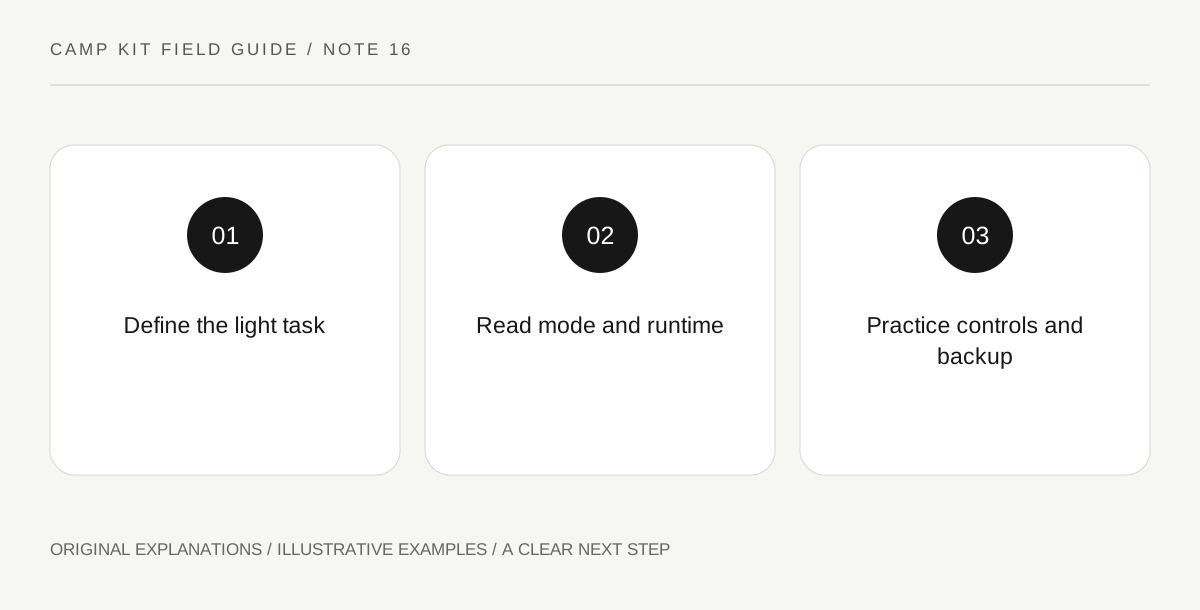
Original explanatory diagram. Read the full method and limitations below.
List the light tasks
Think through pitching, finding equipment, preparing for sleep and moving around the permitted campsite. Close work and looking farther ahead may call for different beam characteristics. The goal is useful illumination for the task, not the highest advertised number regardless of how it is produced.
Keep nighttime travel ambitions within your experience and route plan. A stronger lamp does not make an unfamiliar hazardous route appropriate. If you need specialist lighting for a demanding activity, use suitable technical guidance rather than treating a general camping comparison as approval for that activity. The equipment decision should follow the task and its limits.
Read mode and runtime together
Manufacturer runtime information belongs to a particular lighting mode and test context. A maximum-brightness claim and a longest-runtime claim may refer to different settings. Petzl’s guidance explains the trade-off between output and duration, so compare corresponding information rather than combining unrelated best-case numbers.
Check whether the lamp regulates output or gradually dims, and what any reserve mode means in the actual instructions. A lamp that still glows at the end of a stated test is not automatically providing the output you need for every task. Keep the mode definition alongside the runtime figure when making a comparison.
Practice controls and power compatibility
Try the controls in a low-consequence setting before departure. Learn normal mode changes, lockout and battery access according to the manual. Check that any rechargeable pack, disposable batteries or cable are approved for that exact model and version.
A connector that looks familiar does not establish every charging or battery combination as suitable. Plan the supported power arrangement and inspect contacts, covers and cables. Keep small replacement components organized so they can be found when needed. A phone battery shared across navigation, communication and lighting also creates a dependency worth considering rather than discovering after all three tasks compete for it.
Keep camp courtesy and a failure plan
Aim light away from other people’s faces and use an appropriate setting for close tasks. A headlamp worn at eye level can be uncomfortable for someone across a table even when it is useful for its wearer. Learn how to change settings without repeatedly cycling a bright beam through another person’s view.
Keep a realistic response to a failed lamp or depleted power source. An alternative must be suitable for the intended task and available when needed, not buried in someone else’s bag after the group separates. After the trip, follow the product’s cleaning and storage guidance. The useful outcome is a dependable lighting arrangement with known controls and limits, not a single impressive specification.
A planning scenario
An illustrative camper sees a lamp advertised with a high output and a very long duration. The detailed table shows those figures belong to different modes. They compare the mode actually suitable for camp tasks, check approved batteries and practice the controls. The example does not verify any product’s runtime; it shows why reading corresponding fields gives a clearer decision than combining headline claims.
Practical checks
Optional checkboxes save only in this browser.
Questions that come up
Does maximum brightness last for the longest advertised runtime?
Do not assume so. Read the manufacturer’s mode-specific information and test definitions; the maximum output and longest duration may describe different settings.
Can any rechargeable battery of the same shape be used?
No. Use the battery or power arrangement approved for the exact lamp. Similar appearance or connector fit does not establish electrical or charging compatibility.
References and scope
These sources support the factual background. Examples and exercises are original illustrative teaching material. References do not imply endorsement.
- Petzl: Brightness and burn-time trade-offs — Lighting output and runtime must be interpreted together.
- Rocky Mountain National Park: Wilderness planning checklist — A destination-specific example of an overnight equipment system and changing seasonal needs.