Camping Water Treatment: Choose for the Hazard, Not Just the Filter Size
A small filter is not automatically a complete water-treatment plan. Different methods address different hazards, and the equipment has conditions of use. Establish what is known about your water source, read appropriate public-health guidance and match the exact product instructions before treating a clear stream as safe.
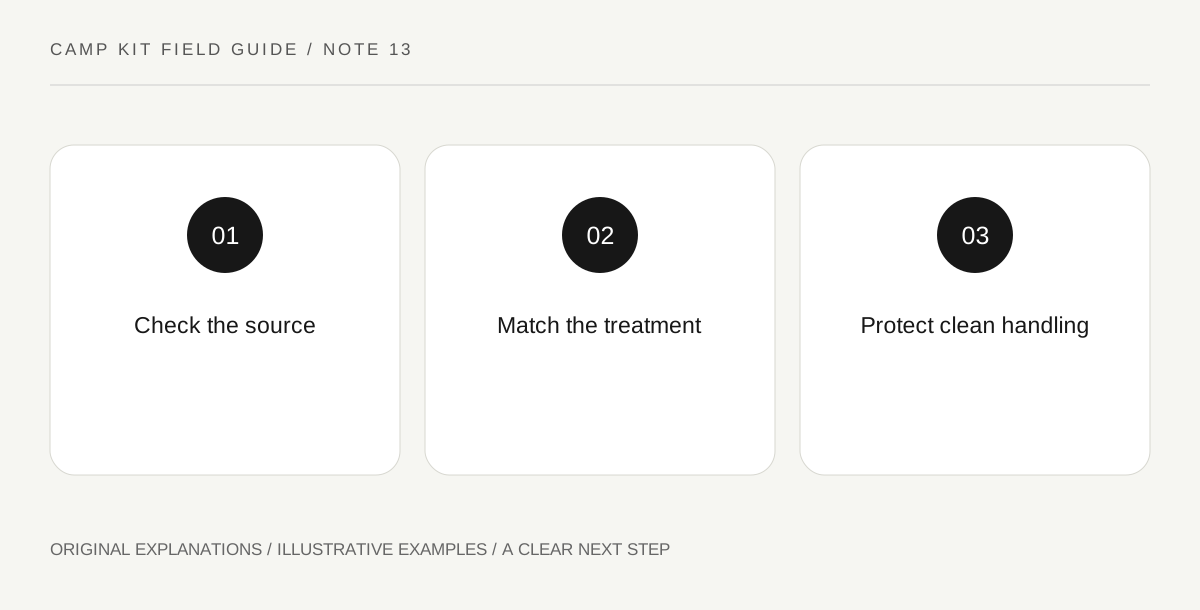
Original explanatory diagram. Read the full method and limitations below.
Start with source information
Check current land-manager information about potable supplies, seasonal availability and any contamination advisory. Water that looks clear can still contain disease-causing organisms. A tap shown on an old map may also be unavailable or untreated during the actual trip.
If harmful chemical contamination is suspected, ordinary boiling or disinfecting does not make that water safe. Use another suitable source and follow official guidance. Do not assume that a small device marketed for outdoor use removes every chemical, salt or biological hazard. The water-source decision comes before comparing packed size or advertised flow rate.
Read what each treatment actually addresses
Public-health guidance distinguishes methods such as boiling, filtration and disinfection. Products also differ in the organisms or contaminants they are designed to address. A broad word such as purifier or filter should lead you to the exact performance information and instructions, not replace them.
The CDC identifies boiling as a reliable method for killing germs and describes filtering followed by disinfection as another approach. Read the current detailed guidance for the situation, then follow the chosen products’ instructions, including limitations. This article does not provide an improvised chemical dose, contact time or universal treatment sequence for every source.
Plan a clean and untreated-water workflow
Identify which container or connection handles untreated water and which receives treated water. Practice the approved assembly without contaminating clean outlets or bottle openings. A compatible thread or hose arrangement should be verified against the product instructions rather than forced into place.
Keep cleaning and storage requirements with the kit. A bottle used to collect untreated water does not become a clean drinking container simply because a filter is later attached elsewhere. The specific product system and public-health guidance determine the correct handling method. A clear separation plan is easier to follow than trying to remember which unmarked bag was used for what.
Consider damage and a suitable alternative
Some treatment equipment can be damaged by freezing, impact or wear. The cited manufacturer guidance explains that suspected damage can require a model-specific integrity check. Follow the exact manual and do not invent a home test that cannot establish the device’s function.
Before departure, decide what happens if the source is unavailable or the system cannot be relied on. That might require another verified supply, a suitable alternative treatment method or a route change. A spare item only helps if it addresses the relevant hazard and can be used correctly. If the water plan remains unresolved, changing the trip is more appropriate than assuming clear appearance makes treatment unnecessary.
A planning scenario
An illustrative pair plans to refill from a stream but has only checked that it appears on a map. They verify current source information, read the treatment device’s actual capabilities and establish separate untreated and clean containers. They also identify an alternative if the source is dry or the device is damaged. This scenario is a planning exercise, not evidence that a particular stream, filter or combination is safe.
Practical checks
Optional checkboxes save only in this browser.
Questions that come up
Does clear mountain water need no treatment?
Appearance cannot establish microbiological safety. Follow appropriate public-health and land-manager guidance for the actual source rather than judging by clarity alone.
Can boiling remove every type of contamination?
No. The CDC warns that water containing harmful chemicals or toxins cannot be made safe by ordinary boiling or disinfection. Use an appropriate different source and official guidance.
References and scope
These sources support the factual background. Examples and exercises are original illustrative teaching material. References do not imply endorsement.
- CDC: Water treatment for hiking, camping and travel — Water-treatment methods address different hazards and require appropriate product instructions.
- Cascade Designs: Filter integrity after damage — Model-specific integrity checks after freezing or impact and the need for the exact owner manual.