Camping Fuel Planning: Use the Real Menu and Approved Equipment
A generic fuel allowance cannot know your stove, menu, conditions or group. Start with approved equipment and the actual cooking tasks, then use relevant manufacturer information and suitable practice records. Keep an alternative meal plan rather than relying on an invented universal number of boils per container.
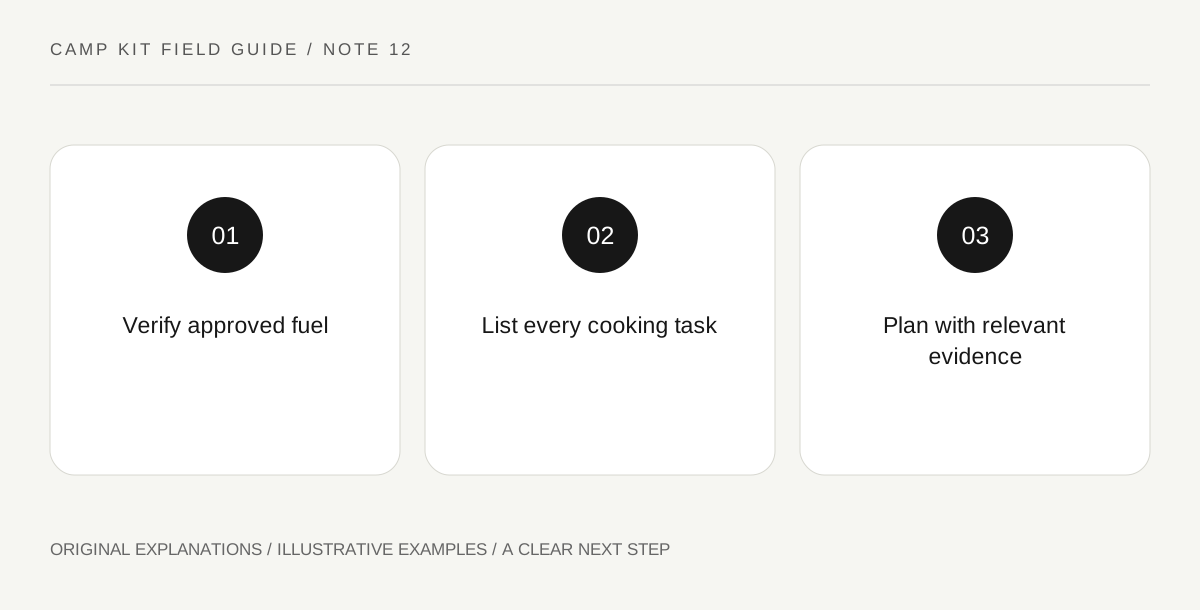
Original explanatory diagram. Read the full method and limitations below.
Confirm the permitted fuel arrangement
Identify the fuel and container types allowed by the exact stove manual. Keep labels and instructions available and follow all storage, transport and handling restrictions. This guide does not give fuel-transfer, canister-modification or operating instructions.
Destination fire restrictions and transport-provider rules also affect what you can bring and use. Check the relevant current sources for the actual journey rather than relying on a previous trip. If a required fuel cannot be transported or used appropriately, change the cooking or travel plan. A planned meal is not a reason to improvise an unsupported fuel system or bypass a restriction.
Write the complete cooking workload
List every intended use of the stove: meals, hot drinks and any water-treatment task in the plan. Include group size and whether food needs simmering rather than a brief heating step. A weekend label alone does not describe this workload.
Check whether the menu can be simplified without compromising food suitability or required water safety. Some meals reduce cooking tasks, but a cold-food alternative must actually be practical for the group and conditions. The point is to define what the equipment needs to accomplish, not fit an arbitrary fuel estimate and then discover that essential tasks were omitted.
Use relevant evidence with a margin
Manufacturer performance figures belong to stated test conditions and a defined system. They are not a guarantee of identical results in wind, cold or another setup. Suitable practice observations can help you understand your own approved equipment, but they also need their conditions recorded.
Do not turn one successful practice session into a universal rule. A fuel plan should account for uncertainty and appropriate reserves without inventing a fixed percentage that suits every trip. For unfamiliar conditions or remote routes, seek competent trip-specific advice. If you cannot establish a suitable plan, revise the trip rather than treating the smallest container that seems plausible as an adequate answer.
Keep fuel quantity and container weight distinct
A container’s gross weight includes the container itself as well as contents. Read the label and relevant manufacturer guidance before interpreting a weight as usable fuel. Do not assume two canisters with different designs have the same empty-container mass.
Any quantity record must remain within the approved equipment, storage and transport arrangements. Never modify a container, attempt an unsupported transfer or use an unapproved measurement method to create a convenient number. The practical planning outcome includes known components, defined cooking tasks, relevant evidence and an alternative if use becomes restricted. It is not a promise that a particular number of grams will always complete a trip.
A planning scenario
A fictional group initially counts only evening meals. Their written menu reveals morning hot drinks and a planned water-treatment task as well. They consult the correct stove information, consider the actual conditions and revise both their approved fuel arrangement and backup meal plan. No burn time or container count is supplied here because those quantities would require trip-specific evidence. The example illustrates omitted-workload detection rather than a fuel recommendation.
Practical checks
Optional checkboxes save only in this browser.
Questions that come up
Can I plan from a universal boils-per-canister number?
Not reliably. Stove system, water amount, conditions and use differ. Manufacturer data have a stated context, and a trip-specific plan should acknowledge uncertainty rather than copy an unrelated figure.
Should I transfer leftover fuel to save weight?
Do not improvise fuel transfer or container modification. Follow the manufacturer and relevant transport restrictions, and choose an approved arrangement rather than creating an unsupported system.
References and scope
These sources support the factual background. Examples and exercises are original illustrative teaching material. References do not imply endorsement.
- MSR: PocketRocket 2 owner instructions — An example of model-specific stove, fuel, cookware and windscreen restrictions; not universal operating instructions.
- National Park Service: Cooking in camp — Meal planning, food organization and campsite cleanup; destination rules take priority.
- Rocky Mountain National Park: Wilderness planning checklist — A destination-specific example of an overnight equipment system and changing seasonal needs.