Camp Cookware: Match the Pot to the Meal, Stove and Cleanup
A compact cookset is useful only if its pieces work with your stove and the meals you actually plan. Pot capacity, support, handles and cleaning access belong in the same decision. Compare the complete cooking task instead of choosing a set from the number of nested accessories alone.
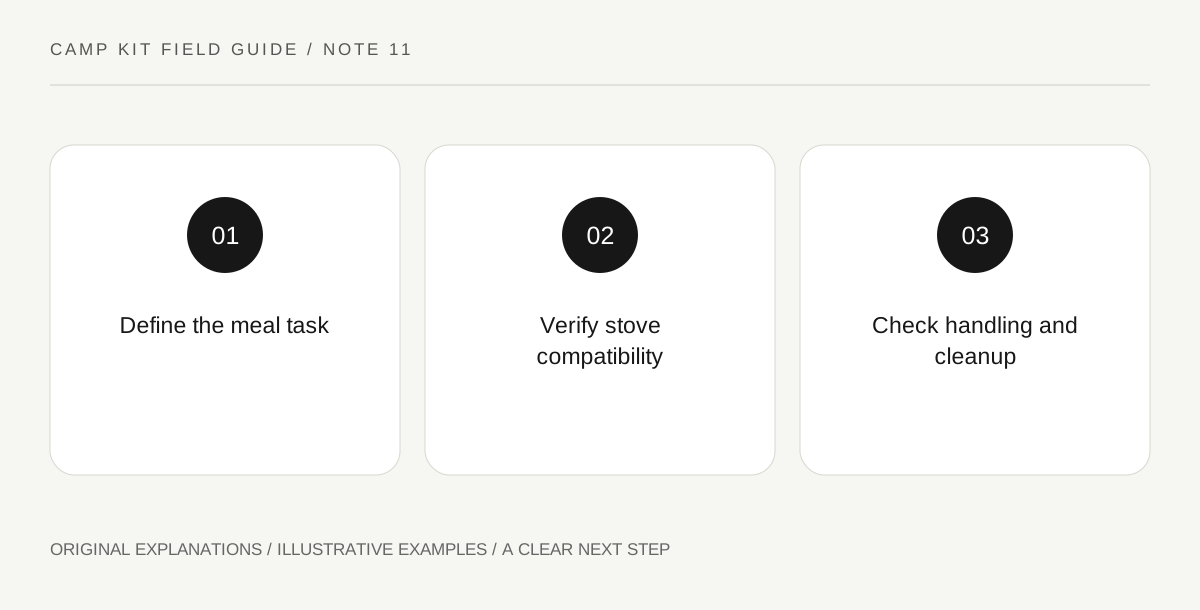
Original explanatory diagram. Read the full method and limitations below.
Choose the cooking task first
List whether meals need only heated water or actual cooking, stirring and portioning. The usable pot capacity must suit that task within the manufacturer’s limits, including space needed to handle contents appropriately. A nominal capacity is not permission to fill a pot to its rim.
For several people, consider whether one shared cooking process is practical or whether separate dietary needs change the plan. A single-pot meal can reduce equipment, but a cookset should follow the actual menu rather than force every meal into a convenient product description. Write down the intended group size and preparation method before comparing sizes.
Verify the stove connection and support
Read cookware dimensions, loaded-weight limits and any integrated-system requirements in the exact stove manual. A pot that nests neatly in a bag may still be unsuitable on the burner. Include water or food when assessing the full loaded arrangement.
Do not add an improvised support to make a mismatched combination appear stable. If using an integrated heat-exchanger pot, verify the approved stove and accessory combinations. The planning question is whether the manufacturer supports the system, not whether the pieces can be balanced together briefly. Resolve a missing specification before relying on the setup in an unfamiliar campsite.
Try handles, lids and serving access
With the equipment cool and empty, practice handling the pot, lid and utensils according to their instructions. Notice whether a folded handle, packed accessory or narrow opening creates an awkward movement. Use appropriate manufacturer-approved handling equipment; do not assume a component remains cool during real cooking.
Check how meals will be served without leaving loose hot equipment in an unstable position. Nesting can be convenient for transport, but all components need to be unpacked and arranged appropriately before use. A packing photograph is not an operating layout. Keep this trial separate from any actual stove practice, which requires the full manual and a suitable permitted outdoor setting.
Include washing and drying in capacity
A pot with inaccessible corners or a very narrow opening can complicate cleanup. Consider the cleaning tools and water arrangements the campsite provides, and follow current disposal rules. A larger frontcountry kit and a compact backpacking setup can have different practical needs.
Inspect nested parts before departure so that a forgotten dirty utensil or incompatible accessory does not become the first discovery at camp. After use, clean and dry the kit according to its instructions. A useful cookware choice connects menu, supported stove configuration, handling and cleanup. The largest set or smallest packed bundle does not automatically resolve all four.
A planning scenario
An illustrative pair plans two meals requiring stirring rather than only hot water. Their candidate tiny pot technically holds the liquid quantity but leaves little usable room for the full meal and does not match the stove’s stated cookware guidance. They revise the pot or menu and practice the cool handling sequence. The example teaches system matching; it does not specify a universally suitable pot volume or demonstrate safe stove operation.
Practical checks
Optional checkboxes save only in this browser.
Questions that come up
Is a nesting cookset automatically a complete cooking system?
No. It is a transport arrangement. Stove compatibility, handling, meal needs and cleaning still require separate checks, and some advertised components may be optional for your trip.
Can any heat-exchanger pot work with any burner?
Do not assume so. Integrated or specialized parts can have specific compatibility restrictions. Use the exact manufacturer instructions and resolve uncertainty before assembling a cooking system.
References and scope
These sources support the factual background. Examples and exercises are original illustrative teaching material. References do not imply endorsement.
- MSR: PocketRocket 2 owner instructions — An example of model-specific stove, fuel, cookware and windscreen restrictions; not universal operating instructions.
- National Park Service: Cooking in camp — Meal planning, food organization and campsite cleanup; destination rules take priority.