Camping Water Carriage: Plan Refills, Containers and the Shared Load
Container capacity and actual water availability are different parts of a camping plan. A large empty jug does not solve an uncertain source, and a small personal bottle may not cover cooking or cleanup tasks. Map the actual uses and refill opportunities before deciding what the group will carry.
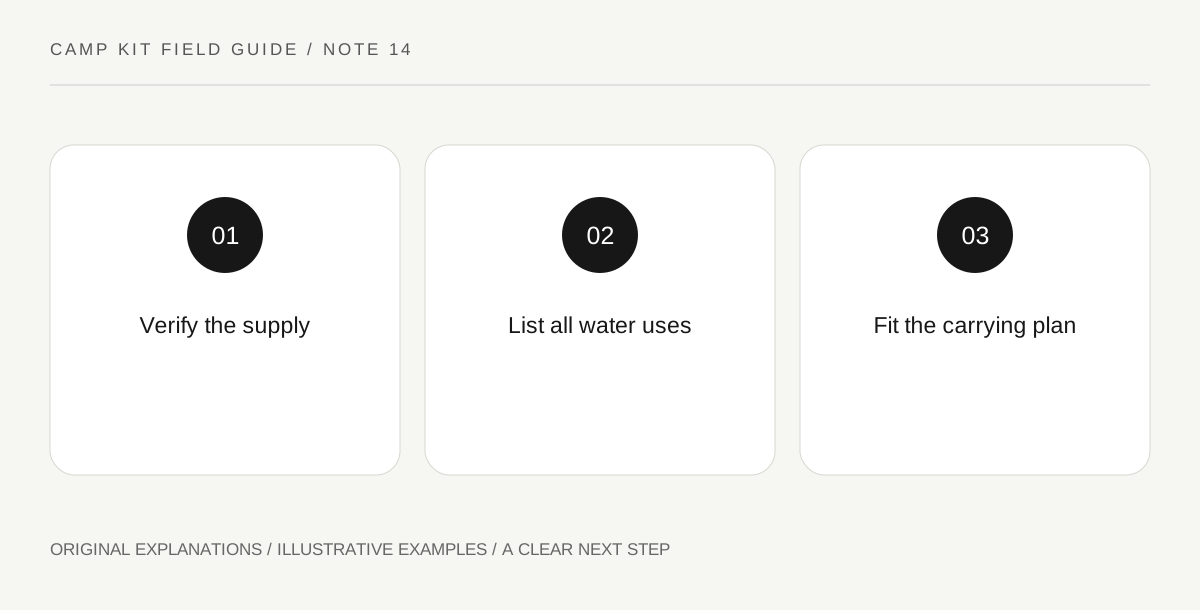
Original explanatory diagram. Read the full method and limitations below.
Verify the refill points for the date
Use current land-manager or campsite information to establish whether supplies are potable, seasonal, temporarily closed or absent. A water symbol on a map is a lead to verify, not a guarantee. Keep the source date and any treatment requirement with the route notes.
Identify the point beyond which the group relies on carried water and what happens if the next planned source is unavailable. Different weather, route difficulty and individual circumstances can change requirements, so this guide does not assign one universal daily volume. Seek competent trip-specific guidance and revise the route when a reliable plan cannot be established.
List uses beyond the drinking bottle
Include drinking, meal preparation, any treatment process and essential hygiene tasks. A group sharing a kitchen has shared uses as well as personal needs. Define those tasks before choosing container sizes, and distinguish usable drinking water from untreated collection water.
For a frontcountry campsite, a bulk container may reduce repeated carrying from a verified tap, but its full weight and handling still matter. For a backpacking route, every container and its contents affect the load. The suitable arrangement follows access, supply reliability and practical use rather than a blanket preference for the largest jug or smallest bottle.
Check carrying and dispensing practicality
Consider whether a filled container fits securely in the pack or vehicle and whether the group can lift and dispense it appropriately. A container that is easy to store empty can be awkward when full. Check handles, caps, intended orientation and product instructions before relying on it at camp.
Do not assume a generic storage bag is suitable for drinking water or that every container tolerates hot liquids. Read its intended use and cleaning guidance. Keep the treatment system’s clean and untreated connections compatible with the chosen containers. A capacity number alone does not establish food-contact suitability, durability or the correct assembly.
Share responsibility without hiding dependencies
Assign who carries personal water, shared cooking water and treatment equipment. If the group might separate, clarify how each person retains an appropriate plan. A single large container carried by one person creates a dependency that should be considered rather than accidentally discovered during a route change.
Record remaining supply at meaningful decisions and follow the actual conditions rather than a timetable alone. This is a planning habit, not a substitute for responding to illness, heat or other changing needs. If the next supply cannot be relied on, make a conservative route decision early. Extra containers cannot compensate for a source or quantity plan that was never resolved.
A planning scenario
A fictional campsite lists a seasonal tap, but the group’s autumn visit may fall after closure. They verify availability before choosing containers, then separate personal drinking needs from shared meal tasks. They also decide how the group will change plans if the verified source becomes unavailable. No litre allowance is prescribed: the scenario teaches why capacity, refill reliability and actual uses must be considered together for the specific trip.
Practical checks
Optional checkboxes save only in this browser.
Questions that come up
Does more container capacity always make the plan better?
No. Capacity must be usable and supported by a reliable supply and carrying arrangement. An oversized awkward container can introduce problems without resolving uncertainty about the source.
Can one fixed daily amount suit every camper and route?
No. Conditions, activity, individual needs and access differ. Use competent guidance for the actual trip rather than treating a generic volume as a universal personal requirement.
References and scope
These sources support the factual background. Examples and exercises are original illustrative teaching material. References do not imply endorsement.
- National Park Service: What to bring camping — Shelter capacity, bedding and the different equipment needs of frontcountry and backcountry camping.
- Rocky Mountain National Park: Wilderness planning checklist — A destination-specific example of an overnight equipment system and changing seasonal needs.
- CDC: Water treatment for hiking, camping and travel — Water-treatment methods address different hazards and require appropriate product instructions.