Camping Dishwashing: Pack a Complete Cleaning and Wastewater Plan
A small bottle of soap does not by itself make a complete campsite cleaning system. Water, suitable containers, drying and wastewater disposal all matter. Plan those tasks for the actual campsite facilities and current land-manager rules before deciding which kitchen accessories to leave at home.
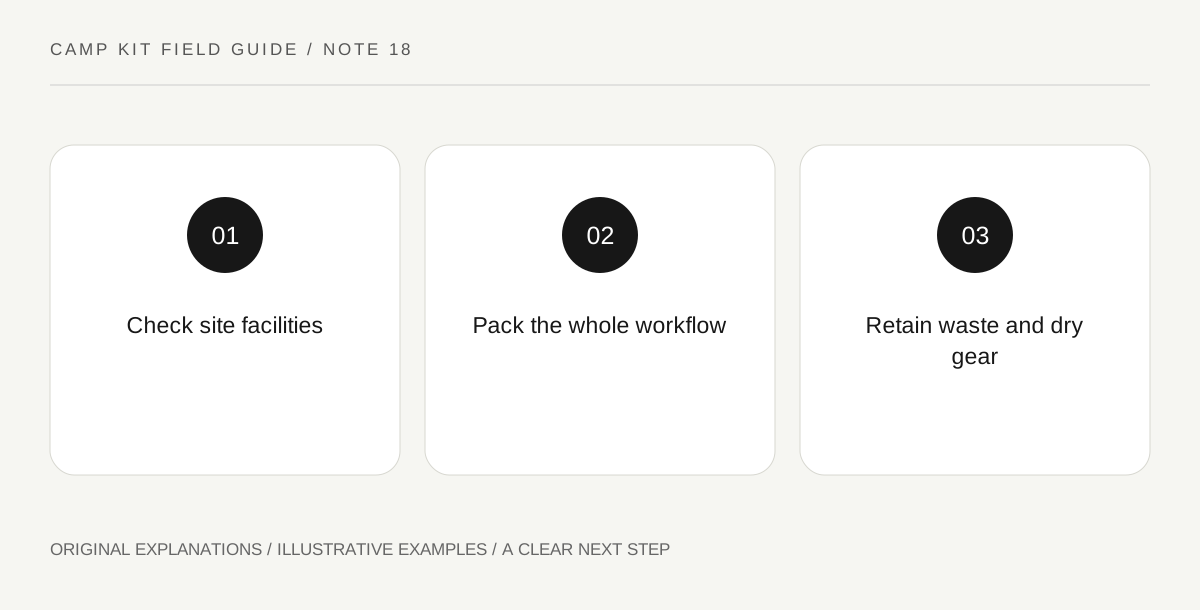
Original explanatory diagram. Read the full method and limitations below.
Check the available facilities
Find out whether the campground provides a designated washing area, potable water and wastewater disposal. Those facilities can differ from a backcountry site without infrastructure. Current campsite information is more useful than assuming every reserved pitch includes a kitchen sink.
Keep local instructions with the meal plan. A convenient tap or nearby stream is not automatically an approved washing or disposal location. If facilities are unavailable, select an appropriate low-impact method within the rules or revise the menu and equipment. The lack of a sink does not remove the need for safe food handling and responsible disposal.
Pack the whole workflow
Consider how used dishes are collected, cleaned, rinsed and dried under the method you will follow. The NPS cooking guidance illustrates that cleanup involves several functions, not only a sponge. Choose containers and tools appropriate for the actual method, group and transport.
Use cleaning or sanitizing products only according to their labels and relevant guidance. Do not copy an improvised chemical mixture from an unrelated context. Keep food-contact equipment and cleaning supplies identified and stored appropriately. A compact kit is useful when its reduced size still supports the complete workflow rather than omitting a necessary step that someone will discover only after dinner.
Keep food scraps and wildlife rules connected
Remove and retain food scraps as required instead of allowing them to accumulate around camp or enter water. Packaging and residues can attract wildlife, and local storage rules may cover rubbish and scented items. The cleanup plan should connect with the same approved storage arrangement used for other required contents.
Biodegradable wording on a product does not grant permission to release it into a stream or lake. Follow the land manager’s actual instructions for wastewater and soap use. Different managed areas can have different systems, so this article does not prescribe one universal disposal distance or method for every campsite.
Make drying and the next meal practical
Arrange drying and storage without placing cleaned utensils back onto an obviously dirty surface. Keep the selected method consistent with product instructions and food-safety guidance. A damp nested cookset forgotten in a closed bag is also an unpleasant discovery at the next trip.
Before departure, inspect the kit for missing components and decide who performs each shared task. A menu that reduces unnecessary cookware may simplify cleanup, but it should still suit the group’s food needs. After returning home, clean, dry and inspect equipment before storage. The complete system is defined by what happens after eating as well as by how impressively the pots nest before the trip.
A planning scenario
An illustrative car-camping group plans several cooked meals but initially packs only one sponge and detergent. Checking the campsite guidance reveals a designated cleanup process and disposal point. They add the appropriate containers, retain scraps as required and organize drying before loading the car. This is a workflow example, not a chemical sanitizing recipe or permission to wash at any convenient outdoor water source.
Practical checks
Optional checkboxes save only in this browser.
Questions that come up
Can biodegradable soap go directly into a stream?
Do not assume that label wording permits it. Follow current land-manager instructions for soap and wastewater, and use the designated method or location.
Does a smaller cookset always mean less cleanup equipment?
Not necessarily. Meal type, group size and the required cleaning method determine the workflow. A compact pot still needs appropriate cleaning, rinsing, drying and disposal arrangements.
References and scope
These sources support the factual background. Examples and exercises are original illustrative teaching material. References do not imply endorsement.
- National Park Service: Cooking in camp — Meal planning, food organization and campsite cleanup; destination rules take priority.
- Yosemite National Park: Allowed food-storage containers — An example of a destination-specific allowed-container list, rather than a universal bear-storage rule.